Monday, January 09, 2006

Happy New Year

My friend asked me to update this blog with something more positive. I have no New Year's resolutions. (There I go using the word "no" right away; it's not looking good for Team Positive.) I have only one major resolution: ask me in person, and I'll be glad to tell you about it. My personal goals are my personal goals regardless of the calendar. I don't change them or create new ones based on the month. I'd like to think I've grown and matured since last January. So much has happened to me since then.
This year might be pretty interesting. I think by next January I'll have completed at least 20 hours of college course work and transitioned out of my current job. I don't know what else might pop up, though. Lisa is no longer an air traffic controller. That's a big change for her having done that for 16 years. Additionally, new opportunities for us to get involved in non-profit work (which is what we really want to be doing) appear certain. So, I feel I do have a fairly positive outlook for this year. Do I want to be thinner, drive the speed limit, eat better, and exercise more? Sure I do, but I don't want to set a bunch of lofty goals now only to fail later. I think the best change happens slowly--sometimes without our being aware of its taking place.
January 2007? It seems like a long way off now. I know that on January 1, 2007, I'll be amazed at how quickly time passed. I don't want to miss a thing between now and then. Maybe on 1/1/07 I'll notice my stomach is smaller, my hair is thinner, I don't eat pizza nearly as much, the Wolverines are going to the BCS Championship Game, my car is still running, and I haven't flunked out of school. Maybe I'll realize I'm nicer, don't swear as often, treat dogs better, babysit more, and drink less soda. These, and other extremely important changes, may happen slowly over the course of this year.
The point is I'm in such a hurry most of the time that I probably wouldn't notice these modifications ocurring even if they were. We are all in a giant hurry. (Been on I-88 lately? Even in a construction zone?) For what? To reach next January? To start the "well, I didn't stick with any of my resolutions, again, so why don't I try to come up with some new ones, or the same ones, but this time I'll try really hard not to forget about them two weeks after I resolve to completely change my life in one year or less" process all over? Okay, I lied. I'll pick one, in addition to the one aforementioned, standing resolution, resolution this year: to slow down. To slow down and notice the things in life that matter. To start to move over and do 55mph, or less. To notice my wife and friends and the changes in their lives that matter. To stop caring how close I was to making that red light. To go an entire football season and not just don't blame, but don't even mention, the ref's. See, this resolution would probably take care of all the others previously mentioned: 'be nicer, not swearing, babysitting more, etc. However, I may never like dogs. In fact, resolving to really slow down may even help my Resolution #1 (aka The Main Thing). Ask me some time; I'd love to tell you what it is.
Have a happy New Year. Did you notice how positive I just was? See? I'm changing already . . .

Friday, December 16, 2005

Victory Assured

Well, I did it: I read all 30+ pages of propaganda the White House and the NSA call the plan for victory in Iraq. Actually, many good points are made in the document.
But like one reporter commented recently, shouldn't President Bush have had a plan for victory before we invaded Iraq? I'm sure the troops there would like to know that we actually had some idea what we were trying to accomplish prior to the occupation.

Wednesday, December 14, 2005

Remember

"You got to cry without weeping
Talk without speaking
Scream without raising your voice"
U2

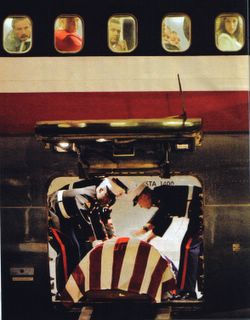
Goodbye Mark. I could never begin to thank you adequately for your life. I hope we will all learn from your time here with us-- and ever after.

Wednesday, December 07, 2005

Long life?


I've Been To The Mountain Top

by Dr. Martin Luther King Jr.

April 3, 1968, Memphis, Tennessee


This was Dr. King's last, and most apocalyptic, sermon. He delivered it, on the
eve of his assassination, at [the Bishop Charles] Mason Temple in Memphis, Tennessee,
on April 3, 1968. Mason Temple is the headquarters of the Church of God in Christ,
the largest African American pentecostal denomination in the United States.


(Excerpts)


The masses of people are rising up. And wherever they are assembled today, whether they are in Johannesburg, South Africa; Nairobi, Kenya: Accra, Ghana; New York City; Atlanta, Georgia; Jackson, Mississippi; or Memphis, Tennessee--the cry is always the same--"We want to be free."

And another reason that I'm happy to live in this period is that we have been forced to a point where we're going to have to grapple with the problems that men have been trying to grapple with through history, but the demands didn't force them to do it. Survival demands that we grapple with them. Men, for years now, have been talking about war and peace. But now, no longer can they just talk about it. It is no longer a choice between violence and nonviolence in this world; it's nonviolence or nonexistence.
That is where we are today. And also in the human rights revolution, if something isn't done, and in a hurry, to bring the colored peoples of the world out of their long years of poverty, their long years of hurt and neglect, the whole world is doomed. Now, I'm just happy that God has allowed me to live in this period, to see what is unfolding. And I'm happy that he's allowed me to be in Memphis.

And that's all this whole thing is about. We aren't engaged in any negative protest and in any negative arguments with anybody. We are saying that we are determined to be men. We are determined to be people. We are saying that we are God's children. And that we don't have to live like we are forced to live.


Secondly, let us keep the issues where they are. The issue is injustice.

And we've got to say to the nation: we know it's coming out. For when people get caught up with that which is right and they are willing to sacrifice for it, there is no stopping point short of victory.

But somewhere I read of the freedom of assembly. Somewhere I read of the freedom of speech. Somewhere I read of the freedom of the press. Somewhere I read that the greatness of America is the right to protest for right. And so just as I say, we aren't going to let any injunction turn us around. We are going on.


We need all of you. And you know what's beautiful to me, is to see all of these ministers of the Gospel. It's a marvelous picture. Who is it that is supposed to articulate the longings and aspirations of the people more than the preacher? Somehow the preacher must be an Amos, and say, "Let justice roll down like waters and righteousness like a mighty stream." Somehow, the preacher must say with Jesus, "The spirit of the Lord is upon me, because he hath anointed me to deal with the problems of the poor."
But I want to thank them all. And I want you to thank them, because so often, preachers aren't concerned about anything but themselves. And I'm always happy to see a relevant ministry.

It's alright to talk about "long white robes over yonder," in all of its symbolism. But ultimately people want some suits and dresses and shoes to wear down here. It's alright to talk about "streets flowing with milk and honey," but God has commanded us to be concerned about the slums down here, and his children who can't eat three square meals a day. It's alright to talk about the new Jerusalem, but one day, God's preacher must talk about the New York, the new Atlanta, the new Philadelphia, the new Los Angeles, the new Memphis, Tennessee. This is what we have to do.

Let us develop a kind of dangerous unselfishness.


That's the question before you tonight. Not, "If I stop to help the sanitation workers, what will happen to all of the hours that I usually spend in my office every day and every week as a pastor?" The question is not, "If I stop to help this man in need, what will happen to me?" "If I do no stop to help the sanitation workers, what will happen to them?" That's the question.

Well, I don't know what will happen now. We've got some difficult days ahead. But it doesn't matter with me now. Because I've been to the mountaintop. And I don't mind. Like anybody, I would like to live a long life. Longevity has its place. But I'm not concerned about that now. I just want to do God's will. And He's allowed me to go up to the mountain. And I've looked over. And I've seen the promised land. I may not get there with you. But I want you to know tonight, that we, as a people will get to the promised land. And I'm happy, tonight. I'm not worried about anything. I'm not fearing any man. Mine eyes have seen the glory of the coming of the Lord.


Back to: DrMartinLutherKingJr.com


From: http://www.drmartinlutherkingjr.com/


Sunday, December 04, 2005

The simplicity of story

“I am just a poor boy and my story's seldom told
I've squandered my resistance for a pocketful of mumbles, such are promises
All lies and jest, still the man hears what he wants to hear
And disregards the rest”

-Simon and Garfunkel

Everyone has a story. Like books on a shelf, each one’s story may be interesting reading to some while others may have difficulty in relating to the narrative of another’s life. All of us have experienced drama, tragedy, and comedy, and without doubt, some may feel his/her life has played out like a documentary: complete with re-enactments and voiceover. However, in reflection, what is life--other than “story?”
“Story doesn’t just tell us something and leave it there; story invites our participation. A good storyteller gathers us into the story. We feel the emotions, get caught up in the drama, identify with the characters, see into nooks and crannies of life that we had overlooked, realize there is more to this business of being human than we had yet explored. If the storyteller is good, doors and windows open.” (Eugene Peterson) How do we begin to connect with another person? We ‘get to know them.’ We share our story. They hear ours. Sometimes, intentionally or otherwise, we find our lives intersecting and joining another’s. Often these parallel courses will last only for a single chapter. On other occasions, our stories merge, and we find, years later, that our story is no longer ours alone. It’s now part of a bigger tale, and suddenly our eyes become opened to a developing plot-line of which we had never dreamed.
In my lifetime, I’ve heard and read many arguments concerning the accuracy and authenticity of the Bible. Who wrote it and when? Is it all true or only partially? Is it: merely a good read or truly the guide for “holy living” as some proclaim? Even those who read it with regularity struggle with questions of the Bible’s relevance in today’s world when its settings are thousands of years old and when the existence of the main character is a continuing hot topic of debate. However you view the Bible, without question, it’s a good story, and few would argue that, historically, people, across culture and throughout time, have always enjoyed a good story. We relate to, and with, story. “Telling a story is the primary . . . way of accounting for life the way we live it. And so when we lose touch with our lives, our souls – story is the best way of getting us back in touch again.” (Peterson)
In this ‘information age,’ the trap of disconnectedness looms large. In antiquity, stories were the only means of transferring significant information to the passing generations. Our present and ever-developing technology has served us in staying up-to-the-minute, but in what? Stock readings and sports scores? Current events? Our over-committed schedules? The latest celebrity gossip? We’ve been sucked in. “We live in an age when story has been pushed from its . . . front-line prominence to a bench on the sidelines . . . Both inside and outside the church, we prefer information over story. But we don’t live our lives by information. We live them in relationships.” (Peterson) Good stories compel us to action and participation, or, at the very least---serious reflection and contemplation. Entertainment wears off; conviction lasts.
Maybe people refuse the Bible out of fear or ignorance. Maybe some miss its relevance and confuse its purpose. Others may simply not ‘have the time.’ Whatever the case for you, stop and look again. “The Bible’s honest stories respect our freedom; they don’t manipulate us, don’t force us, don’t distract us from life. They show us a spacious world in which God creates and saves and blesses. They invite us in as participants in something larger, in something truer. We enter these stories and recognize ourselves as participants, whether willing or unwilling, in the life of God.” (“Living into God’s Story” by Eugene Peterson) We are participants not only in our own life story but also in the life of at least two other people. We are each adding to our story every day. How do you fit into and relate with the stories of other people? How do we begin to understand life? How can we have any hope of knowing someone and being known ourselves? Story. We in the Church have complicated the presentation and representation of God’s story. We’ve made the Bible out to be more mysterious than intended. “Spiritual theology does not so much present us with a moral code and tell us, ‘Live up to this,’ nor does it set out a system of doctrine and say, ‘Think like this.’ The biblical way is to tell a story and invite us, ‘Live into this—this is what it looks like to be human in this God-made and God-ruled world; this is what is involved in becoming and maturing as a human being. We don’t fit into prefabricated moral and mental or religious boxes before we are admitted into the company of God. We are taken seriously just as we are and given place in his story—for it is, after all, God’s story. None of us is the leading character in the story of our lives. God is the larger context and plot in which all our stories find themselves.”
So, what’s your story?


Friday, December 02, 2005


No More Posted by Picasa

No More


“War is a poor chisel to carve out tomorrow.”
Martin Luther King Jr.

“Permanent good can never be the outcome of untruth and violence.”
Gandhi

“There is no honorable way to kill, no gentle way to destroy. There is nothing good in war. Except its ending.”
Lincoln